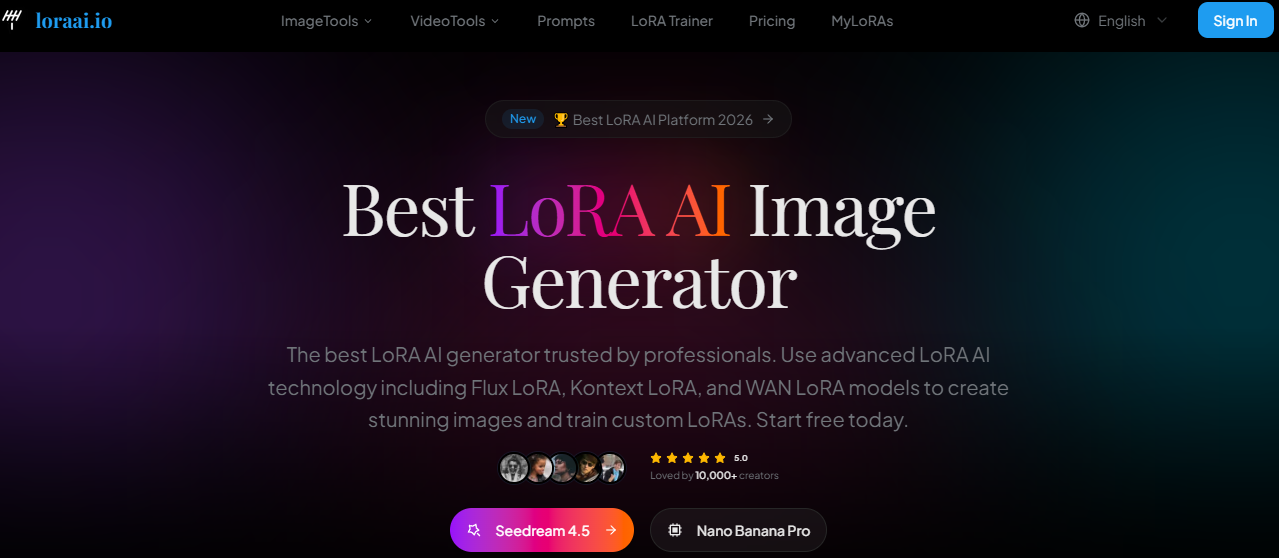
Artificial intelligence is developing rapidly, and large language models (LLMs) like GPT, LLaMA, Diffusion Steady, and Cloud are revolutionizing the industry. However, training and optimizing these large models is expensive, time-consuming, and resource-intensive. This is where LoRA AI comes in.
LoRA AI (Low-Rank Adaptation of Large Language Models) is a powerful and efficient approach that enables developers, businesses, and researchers to optimize pre-trained AI models with minimal computational effort. Instead of retraining billions of parameters, LoRA AI introduces small, trainable layers that adapt the model to specific tasks. This makes adaptation faster, more cost-effective, and more scalable.
What is LoRA AI?
LoRA AI (Low-Rank Adaptation) is a machine learning technique for efficiently optimizing large, pre-trained models. Instead of updating all model parameters, LoRA AI adds a small set of low-rank matrices to specific layers of the neural network. These matrices learn task-specific information while the original model remains fixed.
A simple explanation of LoRA AI:
Imagine a complex AI model as a vast library. Previously, transforming it required rewriting most of its contents. With LoRA AI, you only need to add a few sticky notes with instructions. The library remains unchanged, but the AI now behaves differently according to the task.
Technical Description
LoRA AI works as follows:
- The original model's weights are fixed.
- Trainable, low-rank arrays are added to the layers of interest.
- Only these new arrays are trained.
- These arrays are combined during inference.
This approach significantly reduces:
- GPU and memory usage
- Training time
- Operating costs
Therefore, LoRa AI has become a popular method for fine-tuning low-rank linear models (LLMs), generative AI models, and diffusion models.
Key Features of LoRA AI
LoRA AI stands out for its efficiency, scalability, and flexibility. These are the key SEO-optimized features:
1. Resource Optimization
LoRA AI reduces storage and computational resource requirements by up to 90% compared to traditional methods. This makes it an ideal solution for startups, independent developers, and small businesses that may not have access to high-end GPUs.
2. Faster Training
Due to the reduced number of trainable parameters, LoRA AI models can be fine-tuned in hours instead of days or weeks.
3. Cost-Effective AI Customization
By using fewer GPUs and cloud resources, LoRa AI significantly lowers AI training and deployment costs.
4. High Performance
Despite its lean design, LoRa AI delivers near-perfect performance for fine-tuning, making it ideal for production applications.
5. Model Compatibility
LoRA integrates seamlessly with most popular AI models, including:
- GPT-based models
- LLaMA and LLaMA 2
- Stable Diffusion
- BERT and T5
6. Modular and Scalable Design
You can create multiple LoRa modules on a single model, allowing one base model to handle multiple tasks.
7. Easy Integration
LoRA AI is compatible with popular machine learning frameworks such as PyTorch, Hugging Face Transformers, and Diffusers.
How does LoRA AI work?
Understanding how LoRA AI works will help you use it effectively in real-world projects.
Step 1: Select a Pre-trained Model
Choose a large language or generative model such as GPT, LLaMA, or Diffuser Stable.
Step 2: Modify the Base Model
Keep the key model parameters unchanged to preserve your foundational knowledge.
Step 3: Add Low-Rank Layers
LoRA AI adds small, trainable arrays to specific layers (typically the attention layers).
Step 4: Train with Your Own Data
Train the LoRA layers with your own data, such as customer service conversations, product descriptions, or industry documents.
Step 5: Deploy or Merge
Use the LoRa layers independently or merge them with the base deployment model.
Who uses LoRA AI?
LoRA AI is widely used in industries and businesses.
AI Developers and Engineers
They use LoRA AI to develop and optimize production-ready AI models without complex infrastructure.
Startups and SMEs
LoRA AI enables cost-effective AI customization for customer service, marketing automation, and data analytics.
Researchers and Scientists
LoRA AI enables faster and easier model testing and experimentation.
Content Creators
Creators use LoRA AI with robust models to transform text into images and create custom visuals.
Large Enterprises
Large enterprises use LoRA AI to adapt their internal AI systems to legal, security, and industry-specific requirements.
Use Cases and Applications of LoRA AI
1. Chatbots for Customer Service
Companies optimize their AI models with LoRA AI to provide accurate answers to questions about products and brands.
2. Product Descriptions in E-commerce
LoRA AI generates large volumes of SEO-optimized and brand-appropriate product descriptions.
3. AI Systems in Healthcare
Hospitals use LoRa AI to create AI models for medical terminology, patient care, and clinical documentation.
4. AI-Enabled Legal Assistance
Law firms optimize their models for contract analysis, legal research, and regulatory compliance.
5. Image Generation and Graphic Design
LoRA AI is used to continuously train and deploy models for specific artistic styles, characters, and brand identities.
6. Financial Data Analysis
Banks and fintech companies are adapting AI models for fraud detection, risk analysis, and financial forecasting.
LoRA AI Pricing and Costs
LoRA AI is open source, so there are no upfront licensing fees. However, the cost depends on the following factors:
Hardware costs
- Local GPU usage
- Cloud GPU services (AWS, Google Cloud, Azure, RunPod)
Cloud platform costs
- GPU hourly rate
- Storage costs
- API usage costs
Software and Tools
Most LoRA AI tools are free, including:
- Hugging Face
- PyTorch
- PEFT
Price Estimates
- Small projects: $10 to $50 per month
- Medium projects: $100 to $500 per month
- Large projects: $1,000 or more
Advantages of LoRA AI
- Lower training costs
- Faster deployment
- Scalable architecture
- High model performance
- Flexible customization options
Limitations of LoRA AI
- Slight performance loss compared to full fine-tuning.
- Technical expertise required
- Not recommended for large domain shifts
FAQs
Q: What is LoRA AI?
LoRA AI is a low-rank adaptation of large language models.
Q: Is LoRA AI free?
Yes, LoRA AI is open source. However, using it may incur cloud or hardware costs.
Q: Is LoRA AI compatible with GPT models?
Yes, LoRA AI works with GPT-based models and other transformer models.
Q: Is LoRA AI suitable for beginners?
With basic knowledge of Python and machine learning, beginners can get started with LoRA AI using Hugging Face's tutorials and tools.
Q: Does LoRA AI reduce model accuracy?
LoRA AI achieves near-perfect accuracy with significantly reduced resource usage.
Conclusion: Is LoRA AI worthwhile?
LoRA AI is a revolutionary technology for anyone looking to efficiently and cost-effectively adapt large language models. By reducing computational overhead, accelerating training, and maintaining high performance, LoRA AI empowers developers, businesses, and creatives to build powerful AI solutions without significant infrastructure investments.
Whether you're developing chatbots for customer service, generating SEO content, training AI systems for healthcare, or creating custom AI graphics, LoRA AI provides a scalable, flexible, and future-proof solution.
If AI innovation is a priority for you beyond 2026, LoRA AI is not just an option – it's a true competitive advantage.