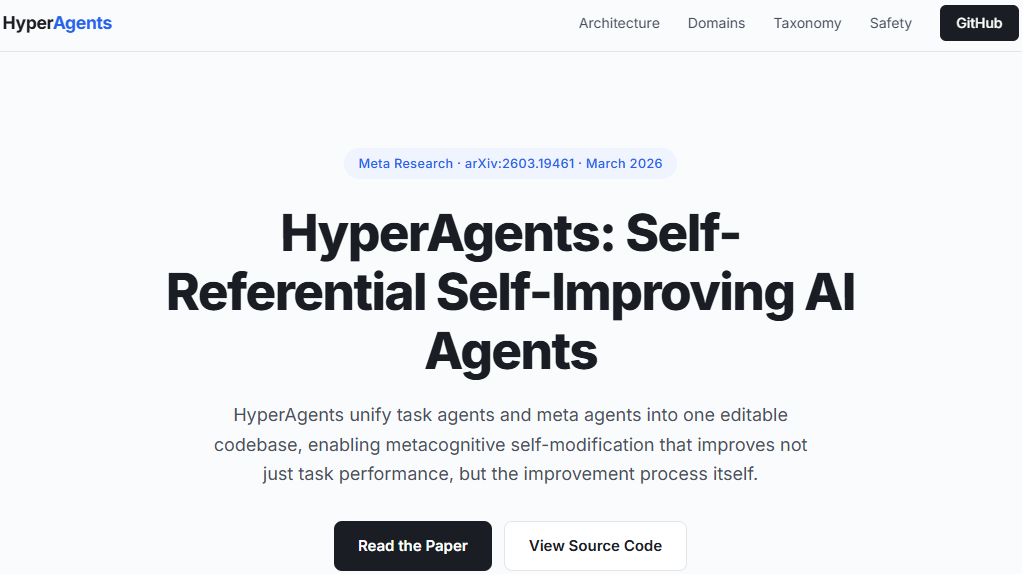
HyperAgents takes the concept of a dynamic Document Management System (DMS) far beyond simple task planning. Its primary goal is to integrate tasks and meta-agents into a single, customizable program, thereby enabling the system to enhance and continuously scale its efficiency.
What are HyperAgents?
HyperAgents operate autonomously on your behalf, independently executing the tasks assigned to them. While created by the developers behind Airtable, Hyperagents AI is a standalone product available at airesult.ai, rather than residing within your Airtable account.
The principle is simple: instead of manually performing repetitive and clearly defined tasks, you delegate them to an agent. Each agent operates based on a system query that serves as both a task description and a user guide; this query is referenced during every execution. You can build an entire team of agents within HyperAgents, with each agent handling distinct tasks and possessing its own set of tools, resources, and budget limits.
Key features of HyperAgents:
- Frontier-based agents
- Learning and skill development
- Deployable agent roles
- Agent fleet monitoring
- Enterprise integration
How does HyperAgent work?
The Hyperagents paper architecture consists of three components:
1. Self-Presentation Layer
The agent maintains a structured representation of its own source code:
- Current implementation of all modules
- Configuration parameters and hyperparameters
- Tool definitions and API schemas
- Decision logic and control flow
This is not merely text; it is a semantic graph that the agent can query, analyse, and manipulate.
2. Improvement Engine
After achieving a goal (for example, "reducing API latency" or "improving error handling"), the agent executes the following steps:
- Analyses the existing implementation to identify bottlenecks.
- Searches for solutions within documentation and examples.
- Generates potential improvements.
- Simulates the outcome in a testing environment.
- Selects improvements that meet safety criteria.
3. Deployment Mechanism
Approved changes are deployed atomically:
- Integration with version control (commits with metadata).
- Rollback functionality (previous versions are preserved).
- Progressive deployment (canary deployment).
- Integration with monitoring (performance monitoring).
Foundation for future development.
This article features Pooya Golchian, a leading expert in AI research. Other topics include:
- Formal verification for AI: A tutorial on using theorem provers to verify the properties of AI systems, including practical examples in Coq or Lean.
- Constitutional AI vs HyperAgents: A comparative analysis of different approaches to AI safety and self-improvement.
- Designing self-learning systems: A practical guide to implementing limited self-improvement within a safety-constrained agent framework.
- Recursive intelligence hypothesis: Examining the theoretical limits and possibilities of recursive self-improvement in AI systems.
- Regulatory implications: Analysing the integration of self-learning AI systems into new AI governance frameworks and safety standards.
Pros and Cons of HyperAgents
Pros:
- High-quality results.
- I appreciate the small window that accurately displays the credits used for each task.
- The tool includes image and video generators.
- It correctly indicates that it cannot access real-time data and operates based on estimates.
Cons:
- It is somewhat expensive to use, especially considering the high cost of search tasks.
Conclusion
HyperAgents is a modern AI agent platform that simplifies complex workflows and automates repetitive tasks more efficiently. Whether you are a developer, a manager, or a member of a growing team, HyperAgents provides flexible tools to boost productivity and reduce manual effort. Before adopting any AI solution, it is important to evaluate its features, integrations, pricing, and security to ensure it meets your specific needs. With advancements in AI automation, Hyperagents AI is establishing itself as an excellent choice for organisations looking to optimise operations and create smarter, more scalable workflows.