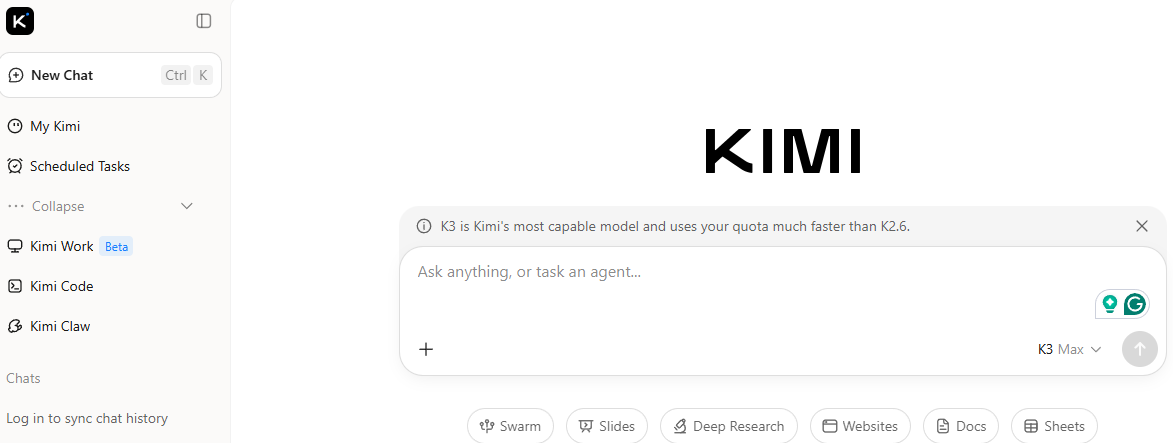
Artificial Intelligence (AI) is evolving rapidly, with new models making headlines every few months. This week, Kimi K3 is the talk of the town. Developed by the Beijing-based AI company Moonshot AI, this latest flagship model is quickly establishing itself as a serious contender for market leadership.
Unlike many AI models that offer only incremental improvements, Kimi K3 has garnered global attention thanks to its combination of extensive features, superior programming capabilities, agentic functions, and an open approach. Early reviews have placed it at the top of various programming rankings. Industry analysts consider it one of the most powerful OpenAI models to date.
This release has sparked intense discussion within the AI industry—not just regarding its technical capabilities, but also about how it could transform open AI enterprise deployment, developer workflows, and the global competition between Chinese and American AI companies.
What is Kimi K3?
Kimi K3 is the latest Large Language Model (LLM) from Moonshot AI, the company behind the Kimi AI assistant. It is designed for advanced reasoning, software development, long-context understanding, and AI agent workflows.
According to Moonshot AI, K3 aims to help developers, businesses, and researchers automate complex tasks—such as writing production-ready software, creating presentations, analysing documents, and coordinating multi-step AI workflows.
A key reason for K3's popularity is the open access to its weights. This offers businesses greater flexibility compared to proprietary commercial AI models.
Why is Kimi K3 generating so much excitement?
Kimi K3 is one of this year's most talked-about AI innovations for several reasons:
1. The world's largest open-weight AI model
Moonshot AI claims that K3 has approximately 2.8 trillion parameters, making it the largest open-weight language model released to date.
2. Exceptional coding performance
Independent benchmarking reports demonstrate K3's exceptional performance in software and frontend development.
The model quickly rose to the top spot in Arena's frontend coding rankings. This indicates that open AI architectures can now compete with leading proprietary systems for specialized workloads.
3. Enterprise-focused architecture
Instead of forcing organizations to rely solely on cloud APIs, K3 allows them to customize deployments, integrate internal knowledge bases, and maintain greater control over sensitive data.
This flexibility is particularly appealing to the finance, healthcare, software, and government sectors.
4. Competitive operating costs
Reports indicate that Kimi K3 offers significantly lower prediction costs compared to some high-end AI systems, making advanced AI more accessible to developers and startups.
Key Features of Kimi K3
Advanced Programming Assistant
K3 excels in:
- Python
- JavaScript
- TypeScript
- React
- Next.js
- Debugging
- Refactoring
- Code optimization
- API generation
Agentic AI
This model can execute complex workflows rather than just responding to individual requests.
Examples:
- Project planning
- Automated research
- Document generation
- Web development
- Execution of programming tasks
- Data analysis
Large Context Management
Kimi supports very large context windows by default.
This allows users to analyze:
- Large PDFs
- Scientific articles
- Entire code repositories
- Books
- Technical documentation without needing to break it down into multiple queries.
Improved Reasoning Capabilities
Moonshot AI enhances logical reasoning quality in the following areas:
- Mathematics
- Logical analysis
- Programming
- Business planning
- Research
Productivity Tools
K3 also enables:
- Presentation creation
- Knowledge management
- AI research
- Multi-agent workflows
- Document summarisation using the Kimi ecosystem
How does Kimi K3 compare to previous Kimi models?
Compared to earlier versions of Kimi, K3 offers improvements in the following areas:
- Coding accuracy
- Logic quality
- Agent orchestration
- Scalability
- Enterprise-grade deployment
- Multimodal workflows
Additionally, it builds upon Moonshot AI’s rich context modelling and previous work on agent-based AI.
Why is this important for businesses?
Large enterprises are increasingly seeking AI that can run on their own infrastructure.
Benefits include:
- Enhanced data privacy
- Reduced API costs
- Easier setup
- Regulatory compliance
- Reduced vendor lock-in
For industries handling sensitive information, open web models offer greater deployment flexibility compared to relying solely on cloud services.
Market impact
The impact of this announcement extended beyond just developers.
Financial markets also reacted. Investors viewed Kimi K3 as further evidence that Chinese AI companies are rapidly catching up with leading US AI firms. Some analysts compared the market reaction to DeepSeek's earlier success, expressing concern that the emergence of more powerful and cost-effective models could put pressure on investments in AI infrastructure.
Challenges and limitations
Despite the excitement, Kimi K3 has also faced criticism.
Some experts argue that leading proprietary models still outperform it in certain general reasoning tasks. Others point out that deploying such a massive model requires immense computational resources, limiting its practical use for smaller companies. Extensive discussions regarding model training and pruning methods also raise questions, even though these topics remain subjects of debate within the industry.
What does this mean for the AI industry?
Kimi K3 highlights several key trends:
- The OpenAI market is becoming increasingly competitive.
- Chinese AI companies are accelerating their innovation efforts.
- Businesses are demanding greater deployment flexibility.
- Competition is driving down costs and boosting productivity.
- Developers now have access to options that are more powerful than proprietary systems.
Rather than instantly overtaking leading AI companies, Kimi K3 expands the ecosystem and offers companies more choices when selecting AI platforms.
Conclusion
Kimi K3 stands out as one of the most significant AI innovations of 2026. Its scalable architecture, powerful coding capabilities, open-source availability, and focus on enterprise customers have made it a topic of discussion within the AI community.
Only time will tell if it can fundamentally reshape the competitive landscape. However, its release underscores the rapid pace of the global AI race. Kimi K3 serves as a benchmark for developers, researchers, and companies evaluating next-generation AI tools, especially as new real-world applications and independent performance metrics continue to emerge.